Research

Job market paper

Front-Loading Recruitment Before Negative Earnings Surprises

with Juan Manuel García Lara, and Bing Guo

We study how firms adjust recruitment in anticipation of a negative earnings surprise. Using 13.9 million U.S. online job postings from 2011 to 2024, we document that firms with negative earnings surprises shift job postings from after to before the earnings announcement. We refer to this intertemporal reallocation as front-loading, and show that it reflects a shift in recruitment timing rather than an increase in labor demand. Front-loading firms exhibit average net hiring rates that are 0.562 percentage points higher—equivalent to about 37.4% of the sample mean—than those of bad-news firms that do not front-load, but do not experience more favorable capital market outcomes. We also find that the content of job postings differs for front-loaders. Overall, our results highlight that negative earnings surprises create labor-market frictions that affect recruitment.

Extended abstract & figure

We examine whether firms shift recruitment toward the period before unfavorable earnings announcements. Financial reporting informs employment decisions by current and prospective employees (deHaan, Li, and Zhou 2023; Choi, Choi, and Malik 2023). Firms anticipating bad news may therefore have incentives to advertise vacancies before its disclosure. We refer to this shift in posting activity as recruitment front-loading.

Using 13.9 million U.S. online job postings from 2011 to 2024, we find that firms with negative earnings surprises exhibit higher abnormal posting activity before announcements and lower activity afterward. Relative to firms without negative surprises, abnormal posting activity is 9.0% to 13.4% higher during the three preceding quarters. Cumulative abnormal posting activity is 3.7% higher before announcements and 4.0% lower afterward, with no statistically significant full-window difference. This pattern is consistent with a shift in posting timing. Résumé-based employee-flow data show that, among firms with negative surprises, front-loaders have net hiring rates 0.562 percentage points higher than non-front-loaders, or about 37.4% of the sample mean. We do not detect more favorable capital-market outcomes among front-loaders.

Our findings extend research on the labor-market consequences of financial distress and financial reporting (Brown and Matsa 2016; Baghai et al. 2021; Choi, Gipper, and Malik 2023; Graham et al. 2023) by identifying recruitment timing as a potential firm response to forthcoming unfavorable earnings news. They also contribute to research on the information conveyed by job postings and its role in recruitment (Gutiérrez et al. 2020; Cao et al. 2023; Choi, Pacelli, Rennekamp, and Tomar 2023; Sran 2025). Our evidence suggests that increases in job postings can reflect recruitment brought forward ahead of bad news, rather than stronger growth prospects alone.
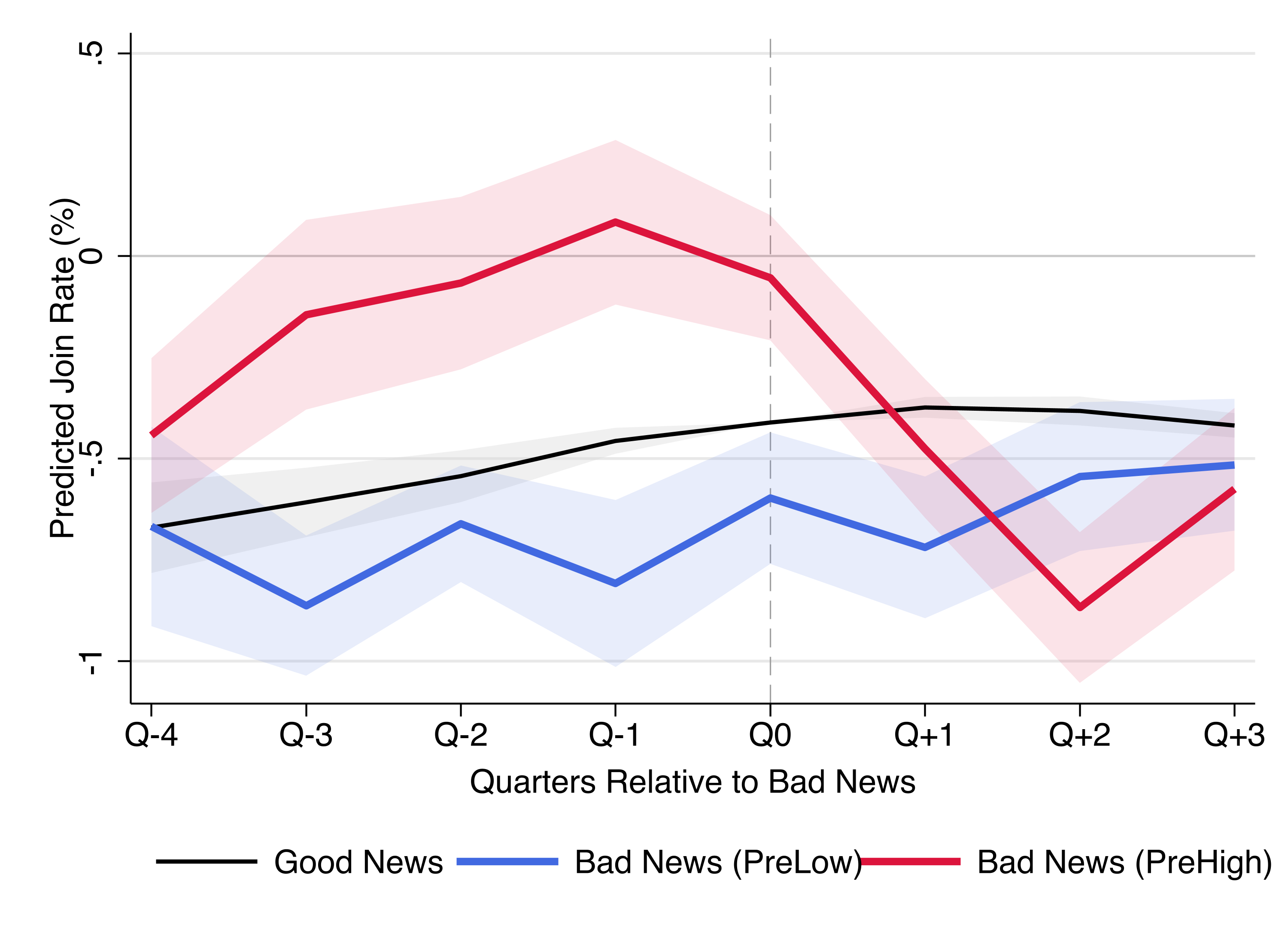
Panel A: predicted abnormal join rate levels, with Good News, PreLow and PreHigh groups and 95% confidence intervals.
Panel A. Predicted abnormal join rate levels around earnings announcements. Black: Good News; blue: bad-news firms with below-median pre-announcement recruitment intensity (PreLow); red: bad-news firms with above-median intensity (PreHigh). Join rates are adjusted by each firm’s three-year historical seasonal average. Q0 is the announcement quarter; shading depicts 95% confidence intervals. Visual adaptation of Figure 1, Panel A; consult the original figure for precise values. Open full-size figure

Presentations: EAA Talent Workshop (IE University, Madrid, November 6–7, 2026, scheduled); 6th Conference for Final-Year Accounting PhDs (Bayes Business School, London, October 15, 2026, scheduled); HKAAA Rookie Camp (Hong Kong, October 3–4, 2026, scheduled); EAA Doctoral Colloquium (Prague, 2026); UC3M Internal Seminar (Madrid, 2026); XIX International Accounting Research Symposium (Madrid, 2025); Madrid Work & Organization Workshop (Madrid, 2025); Finance and Product Markets: Theory, Evidence, and Measurements (Lugano, 2024); XVIII International Accounting Research Symposium (Madrid, 2024); Accounting Summer Camp – Emerging Researchers Consortium (Bozen–Bolzano, 2024); Accounting for Private Entities & Non-investor Stakeholders (HEC Paris, 2024).

  • Earnings announcements
  • Job postings
  • Hiring timing
  • Labor-market frictions
  • Capital markets
Working paper

Reporting Regulation and Human Capital Flows

with Robert M. Bushman, and Wayne R. Landsman

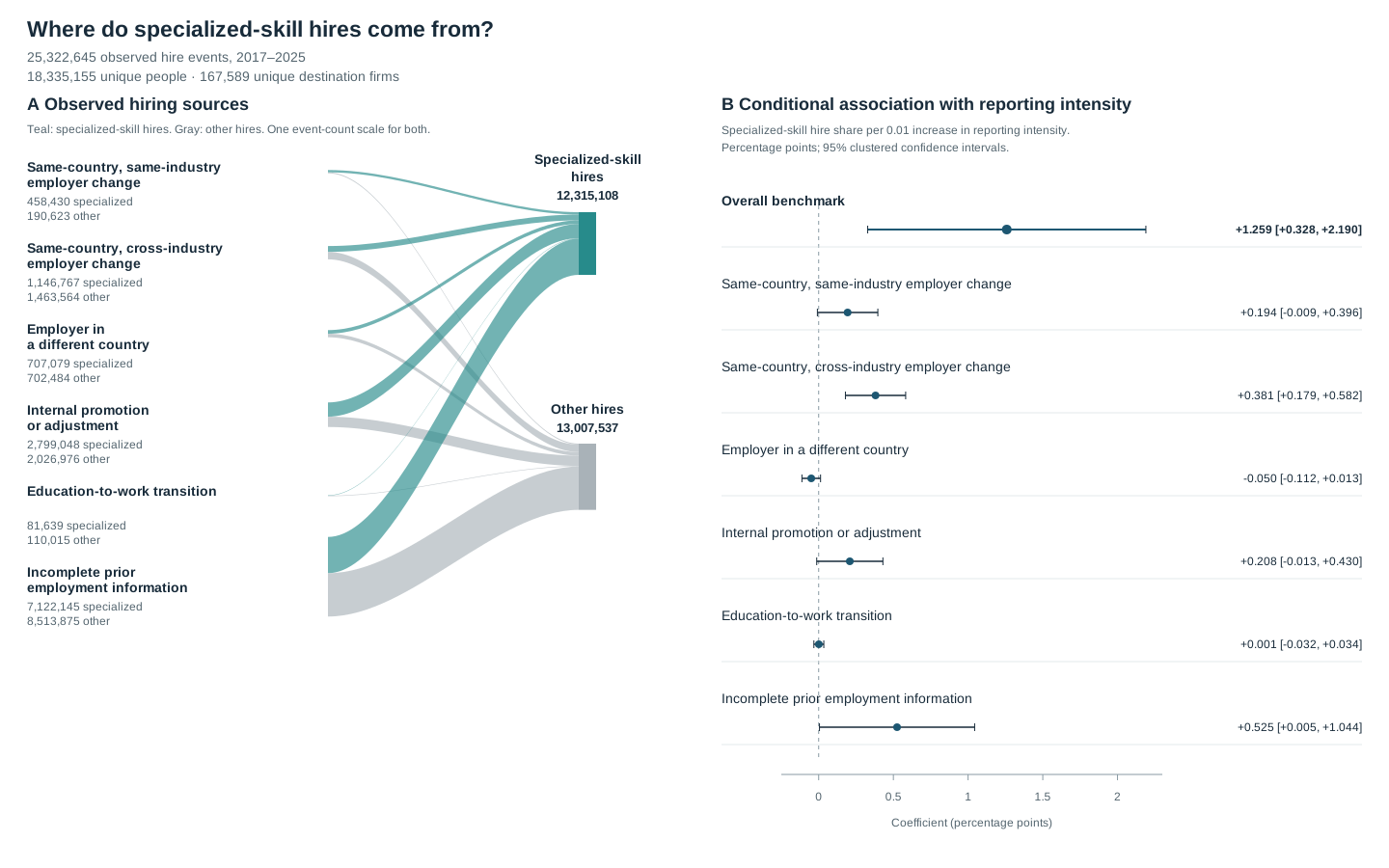
We examine how financial reporting regulation shapes employee flows, focusing on firms’ access to workers with industry-specialized skills. Exploiting European reporting thresholds, we find that higher reporting intensity is associated with a larger share of specialized-skill hires. This association is primarily attributable to cross-industry hires, consistent with greater reporting intensity exposing firms to a broader labor market. The association is more pronounced for informationally opaque firms and for firms with greater exposure to publicly available peer information. Our findings suggest that financial reporting regulation can alleviate information frictions that constrain firms’ access to specialized human capital.

Extended abstract & figure

We examine how financial reporting regulation shapes employee flows, focusing on firms’ access to workers with industry-specialized skills. Financial information can help job seekers assess prospective employers (Choi, Choi, and Malik, 2023; deHAAN, Li and Zhou, 2023). Reporting requirements may facilitate specialized hiring by improving information about employers and their peers. However, proprietary costs may discourage innovation investment (Breuer, Leuz, and Vanhaverbeke, 2025), potentially reducing demand for these workers. Whether reporting regulation facilitates firms’ access to specialized workers is therefore an empirical question.

We combine financial information on European listed and private firms with employee résumé data from 29 countries in the EU area during 2017–2025. Following Breuer, Leuz, and Vanhaverbeke (2025), we construct industry-level reporting intensity using national thresholds and a common European reference population, separating regulatory coverage from cross-country differences in firm-size distributions. We find that higher reporting intensity is associated with a larger share of new hires reporting industry-specialized skills. This association primarily reflects hires from other industries within the same country. It is also stronger for informationally opaque firms and for firms with greater exposure to publicly available peer information, consistent with reporting reducing information frictions in specialized hiring.

Our study extends research on job search and employee outcomes (Choi, Choi, and Malik, 2023; Choi and Gipper, 2024) to the composition and origins of firms’ specialized hiring. We complement evidence on investment efficiency and innovation (Biddle, Hilary, and Verdi, 2009; Breuer, Leuz, and Vanhaverbeke, 2025) by linking reporting environments to the recruitment of specialized labor across industry boundaries. Finally, we extend research on disclosure externalities in financing and patent markets (Shroff, Verdi, and Yost, 2017; Kim and Valentine, 2023) to specialized recruitment. Our separate analyses of employer opacity and peer information suggest that the information relevant to attracting specialized workers need not come from the hiring firm alone.

Specialized-skill hiring: observed hiring sources and conditional associations with reporting intensity.
Observed hiring sources and conditional associations with reporting intensity. Panel A shows hire-event counts; Panel B shows coefficients in percentage points with 95% clustered confidence intervals. Open full-size figure

Presentations: AAA Doctoral Consortium, Dallas, June 2026; Hawaii Accounting Research Conference (University of Hawaii at Hilo, January 2–5, 2027, scheduled).

  • Reporting regulation
  • Specialized human capital
  • Private firms
  • Information frictions
  • Worker skills
Sole-authored work in progress

Interpreting Layoffs

Layoffs attract widespread attention, yet their implications for firms’ operating prospects remain unclear. I examine whether human-capital information and managerial explanations help interpret layoff announcements. Using layoff notices filed under the federal Worker Adjustment and Retraining Notification (WARN) Act, I find that greater workforce churn before a layoff is associated with weaker operating performance afterward. This association is stronger when managers provide less specific explanations for layoffs or offer no explanation in earnings conference calls. These findings suggest that pre-layoff workforce dynamics and the specificity of managerial explanations help distinguish the operating prospects of firms announcing layoffs.

Extended abstract & figure

Layoff announcements attract widespread attention, yet their implications for firms’ performance are difficult to assess. Employment reductions can reflect deteriorating business conditions, efforts to improve efficiency, or both. I examine whether pre-layoff workforce information and managerial explanations help distinguish firms’ subsequent operating prospects. Workforce changes preceding a layoff may provide context that the announced reduction alone does not reveal.

Combining publicly available layoff notices filed under the Worker Adjustment and Retraining Notification (WARN) Act with employee career histories, earnings conference calls, and firm financial information, I find that greater pre-layoff workforce churn is associated with weaker subsequent sales. Churn captures workforce reallocation beyond changes in headcount, providing information about personnel adjustments that precede the layoff. From the WARN quarter through the fourth quarter afterward, a one-standard-deviation increase in pre-layoff churn corresponds to approximately 2.8%, 3.7%, 4.0%, 3.1%, and 3.7% lower conditional sales, respectively, for layoff firms relative to matched controls. This negative association is stronger when managers provide less specific explanations for the layoff or no explanation in earnings conference calls.

The findings contribute to research on employees and corporate information (Call et al., 2017; deHaan et al., 2023; Liang et al., 2024) by showing that employee information can help outsiders interpret an otherwise ambiguous corporate action. They also complement research on conference-call informativeness (Matsumoto, Pronk, and Roelofsen, 2011) by examining the role of workforce histories in assessing restructuring when managerial explanations provide limited context. Together, the evidence suggests that understanding a layoff’s operating implications calls for considering the workforce adjustments that precede it, rather than interpreting the announcement in isolation.

Illustration of high pre-layoff workforce churn, a layoff announcement, vague managerial explanations, and weaker subsequent sales.
Conceptual illustration. High pre-layoff churn is associated with weaker subsequent sales, especially when explanations are vague or absent. Open full-size figure
  • Layoffs
  • WARN notices
  • Managerial explanations
  • Employee flows
  • Incomplete signals
Work in progress

Mandatory Salary Disclosure and Firms’ Use of Job Postings

with Wei Hou

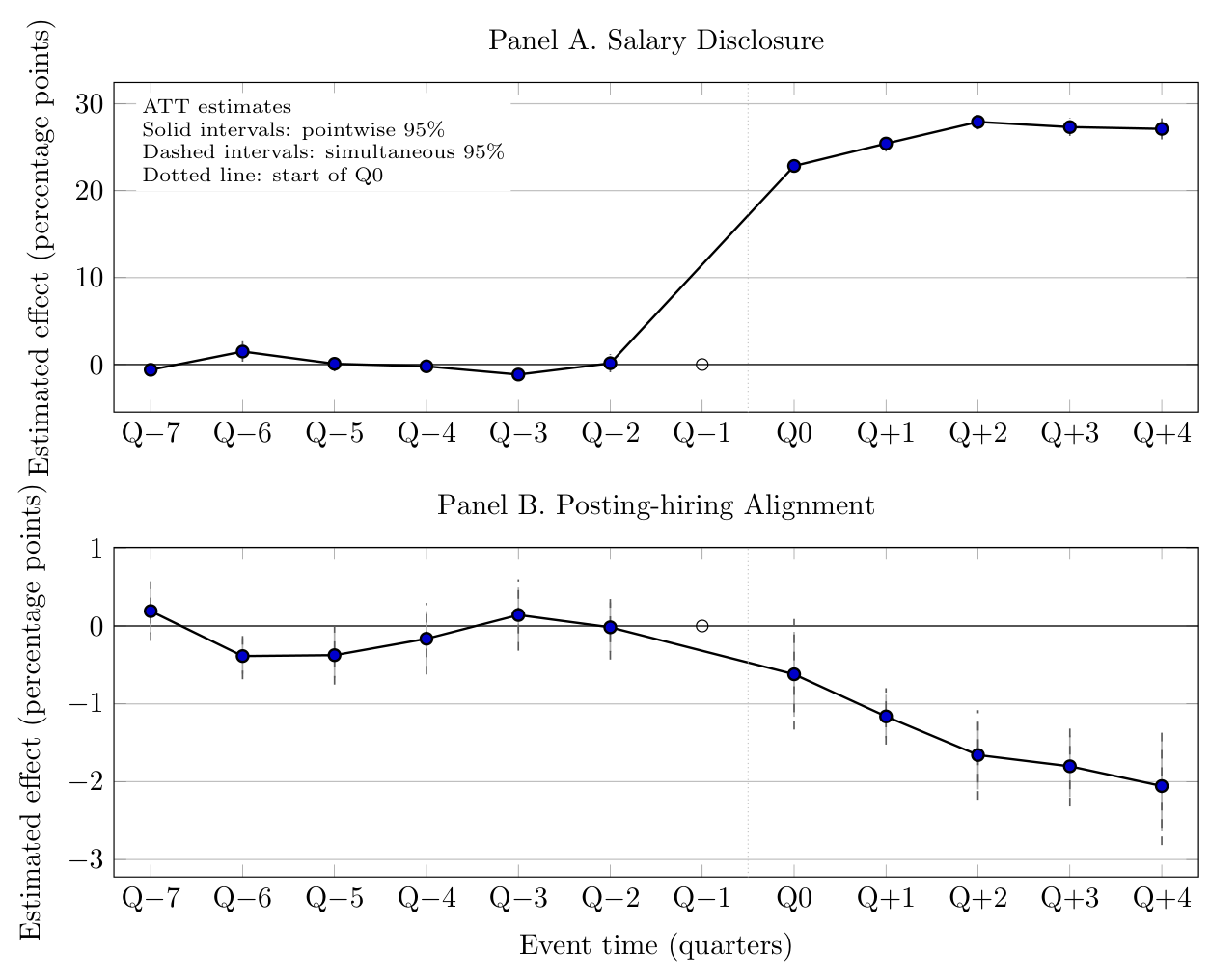
We examine mandatory salary disclosure and firms’ use of job postings. We utilize the staggered adoption of salary-disclosure mandates across six U.S. jurisdictions and find increased salary disclosure but lower posting-hiring alignment: a smaller share of realized hires is preceded by a matching public posting. We further find that the share of anonymous job postings increases, consistent with firms relying less on public postings while continuing to hire. Our findings suggest that salary-disclosure mandates increase the information disclosed within job postings while reducing firms’ use of employer-identified public postings, thereby narrowing the public information available about firms’ labor demand.

Extended abstract & figure

We examine mandatory salary disclosure and firms’ use of job postings. Job postings facilitate recruitment and provide information about firms’ labor demand and prospects to jobseekers, investors, competitors, and researchers (Deming and Kahn 2018; Hershbein and Kahn 2018; Gutiérrez et al. 2020; Marinescu and Wolthoff 2020; Choi, Pacelli, et al. 2023; Sran 2025). Salary-disclosure mandates increase the salary information available in these postings (Arnold et al. 2025; Koenraadt et al. 2026), but may also change employers’ incentives to advertise vacancies publicly. Therefore, more informative postings need not provide a more complete picture of firms’ hiring.

We utilize the staggered adoption of salary-disclosure mandates across six U.S. jurisdictions and combine employer-linked job postings with separately observed hires. We measure posting-hiring alignment (PHA) as the share of eligible hires preceded by a public posting from the same employer, state, and detailed occupation. Over the four quarters following implementation, salary disclosure increases by 26.9 percentage points on average, while PHA declines by 1.7 percentage points. We further find that firms become less likely to use employer-identified public postings while continuing to hire. The share of anonymous job postings also increases.

Our study contributes to research on disclosure regulation and its real effects by showing that greater disclosure within a public channel can coincide with reduced coverage of firms’ underlying activities (Leuz and Wysocki 2016; Kanodia and Sapra 2016). We extend research on corporate information in labor markets (Choi, Choi, and Malik 2023; Sran 2025) by using realized hiring to assess the coverage of public information about firms’ labor demand. Our evidence complements studies of the disclosure and wage effects of pay-transparency mandates (Arnold et al. 2025; Koenraadt et al. 2026) and suggests that their informational consequences depend not only on what firms disclose in postings, but also on how much of their hiring those postings reveal.

Original Figure 1: Salary Disclosure and Posting-hiring Alignment, from Q minus 7 to Q plus 4
Original Figure 1 · Salary Disclosure and Posting-hiring Alignment (PHA). Solid intervals are pointwise 95% confidence intervals; dashed intervals are simultaneous 95% bands. Open full-size figure
  • Mandatory salary disclosure
  • Job postings
  • Salary disclosure
  • Realized hiring
  • Posting-hiring alignment (PHA)
  • Posting activity