Front-Loading Recruitment Before Negative Earnings Surprises
We study how firms adjust recruitment in anticipation of a negative earnings surprise. Using 13.9 million U.S. online job postings from 2011 to 2024, we document that firms with negative earnings surprises shift job postings from after to before the earnings announcement. We refer to this intertemporal reallocation as front-loading, and show that it reflects a shift in recruitment timing rather than an increase in labor demand. Front-loading firms exhibit average net hiring rates that are 0.562 percentage points higher—equivalent to about 37.4% of the sample mean—than those of bad-news firms that do not front-load, but do not experience more favorable capital market outcomes. We also find that the content of job postings differs for front-loaders. Overall, our results highlight that negative earnings surprises create labor-market frictions that affect recruitment.
Extended abstract
We examine whether firms shift recruitment toward the period before unfavorable earnings announcements. Financial reporting informs employment decisions by current and prospective employees (deHaan, Li, and Zhou 2023; Choi, Choi, and Malik 2023). Firms anticipating bad news may therefore have incentives to advertise vacancies before its disclosure. We refer to this shift in posting activity as recruitment front-loading.
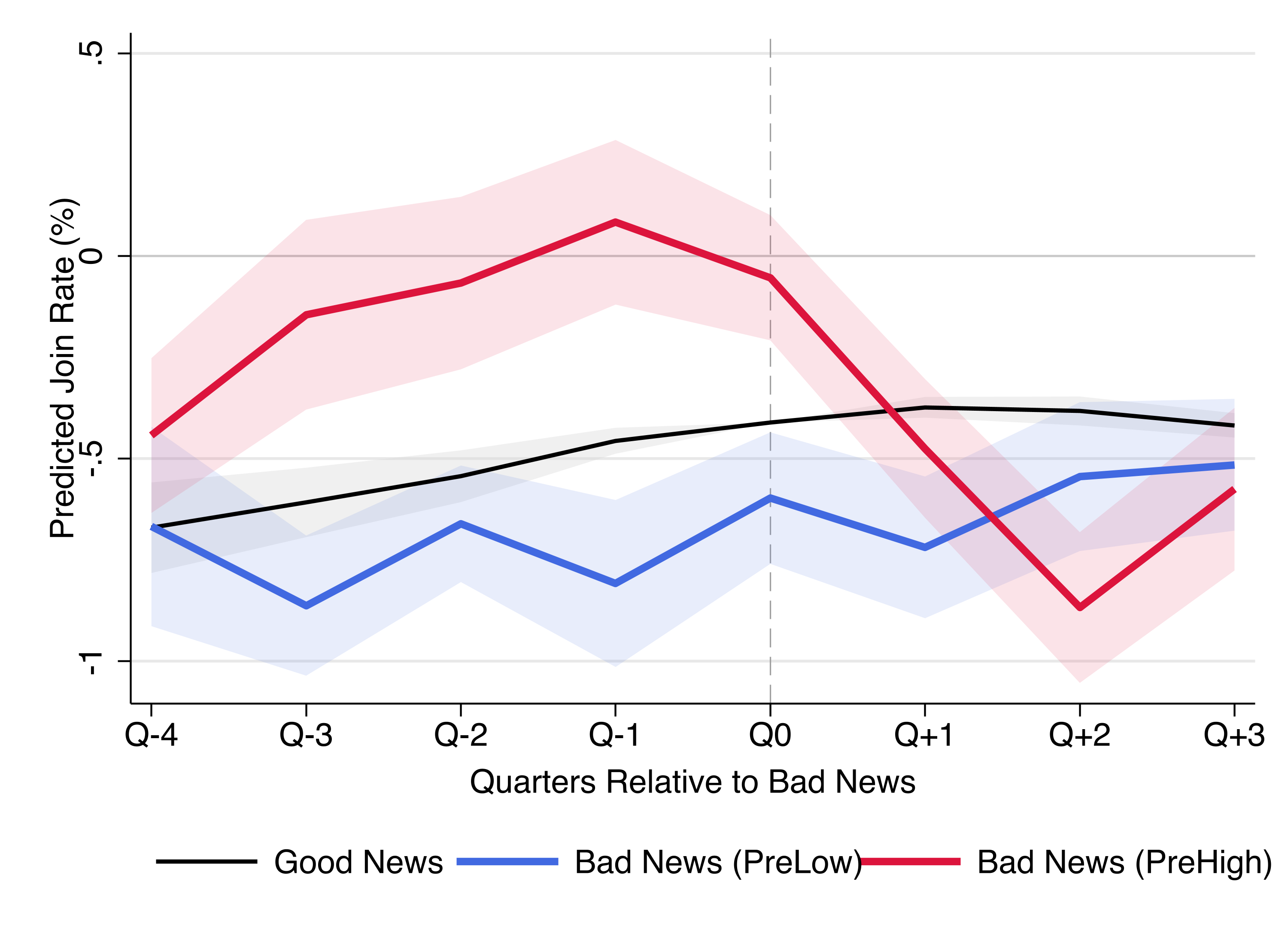
Using 13.9 million U.S. online job postings from 2011 to 2024, we find that firms with negative earnings surprises exhibit higher abnormal posting activity before announcements and lower activity afterward. Relative to firms without negative surprises, abnormal posting activity is 9.0% to 13.4% higher during the three preceding quarters. Cumulative abnormal posting activity is 3.7% higher before announcements and 4.0% lower afterward, with no statistically significant full-window difference. This pattern is consistent with a shift in posting timing. Résumé-based employee-flow data show that, among firms with negative surprises, front-loaders have net hiring rates 0.562 percentage points higher than non-front-loaders, or about 37.4% of the sample mean. We do not detect more favorable capital-market outcomes among front-loaders.
Our findings extend research on the labor-market consequences of financial distress and financial reporting (Brown and Matsa 2016; Baghai et al. 2021; Choi, Gipper, and Malik 2023; Graham et al. 2023) by identifying recruitment timing as a potential firm response to forthcoming unfavorable earnings news. They also contribute to research on the information conveyed by job postings and its role in recruitment (Gutiérrez et al. 2020; Cao et al. 2023; Choi, Pacelli, Rennekamp, and Tomar 2023; Sran 2025). Our evidence suggests that increases in job postings can reflect recruitment brought forward ahead of bad news, rather than stronger growth prospects alone.